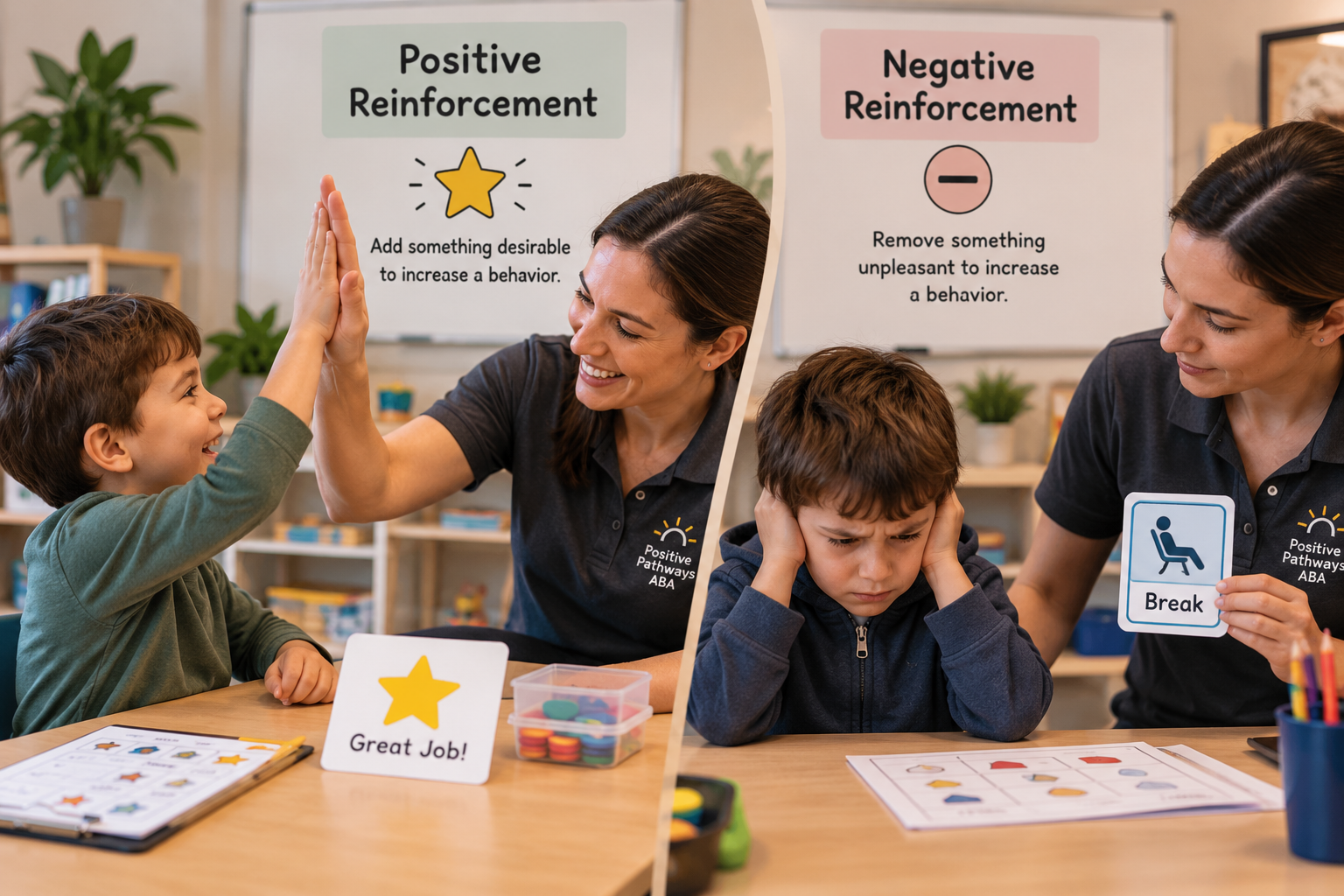

Applied Behavior Analysis (ABA) therapy encourages children to learn key life skills, including communication, social, and independence skills, through individualized treatment plans and positive reinforcement. ABA is about understanding the specific strengths, difficulties, and learning styles of each child and setting meaningful goals to support those children to enhance their everyday functioning.
Meanwhile, parents and caregivers receive valuable assistance from ABA therapy. Parents are able to learn practical strategies as part of caregiver training and work with ABA professionals to help them understand their child’s behavior, promote skill development, and increase consistency between therapy sessions and home life.
ABA therapy supports the child and the parent; therefore, it is a family-centered approach where the child can progress, and the parents are more confident and prepared to support the child’s progress.
How Does ABA Therapy Support Children?
With an individualized strategy, ABA therapy aims to help children make strides towards greater independence by building their communication and engagement skills. Based on their assessment, therapists devise individualized strategies with goals that, when met, can positively impact the child’s and their family’s lives.
Developing Skills to Foster Independence
One of the main aims of ABA therapy is to promote independence and build confidence. In ABA therapy, goals are simplified and broken into smaller steps to ensure success and prevent frustration. Due to the stepwise learning in ABA therapy, children are more likely to join and participate in family and community activities.
ABA aims to promote independence in a variety of skills; examples include:
- Preparation, consumption, and clean up after meals
- Hygiene and grooming
- Household chores
- Daily schedules
- Compliance with instructions
For example, a child may be taught first to pick a clothing item from the pile, then taught to put it on, followed by fastening the clothing, and finally taught the goal of organizing the clothing, before being taught to put on all clothing.
ABA therapy promotes increased independence and has a positive effect on self-confidence.
Improving Communication and Social Skills
Another major area of development within ABA therapy is improving communication skills. Some children may struggle to communicate their needs or preferences verbally, while others may have limited or no spoken language. Children with non-verbal autism may experience additional communication challenges, which can sometimes lead to frustration or challenging behaviors when they are unable to express their needs effectively.
ABA therapy seeks to provide children with the tools to communicate in whatever manner is the most appropriate for them, whether that is by:
- Developing verbal skills
- Enhancing non-verbal skills
- Implementing a picture exchange system
- Providing AAC devices
- Improving skills necessary for conversation.
It can benefit a child who struggles to communicate in this manner to learn skills to express their preferences, emotions, or needs.
Helping Children Generalize Skills Across Different Environments
An important aim of ABA therapy is to encourage the use of skills taught in therapy sessions in other settings. This is called generalization.
It is important to learn skills outside of therapy. Skills learned in therapy must be applied in the environment outside of therapy. ABA therapists work with family members to help skills be used in multiple environments. These environments can include:
- The home
- The school
- Other community locations
- Places where social activities take place
Consider a child who learns a communication skill in therapy. This skill should be used when requesting something from a parent at home or when interacting with a teacher at school.
The goal of generalization is to encourage flexibility and independence in the child.
How Does ABA Therapy Support Parents?
ABA is not child-centered. It also provides parent education, parent support, and helpful strategies that caregivers can incorporate into their everyday routines. With parent training, caregivers have a greater understanding of their child, how to respond appropriately to their child’s behaviors, and how to avoid the mistakes that parents often make that create obstacles to the child’s learning.
Parental involvement is critical to successful ABA, as caregivers are the ones who help the child practice and generalize the skills taught in therapy sessions.
Empowering Parents Through Training and Education
Through parent training, caregivers can learn about their children, analyze their behaviors, and develop effective responses.
Some strategies learned include:
- Incentives of positive reinforcement to motivate proactive behavior
- Methods to aid the development of communication
- Ways to form a consistent daily structure
- Skill development in daily tasks
- Development of a response to negative behavior
With an understanding of the purpose of ABA tactics, parents can support children’s development at home.
Enhancing Daily Life and Lessening Family Stress
Parenting a child with developmental challenges can be difficult and often requires a guess-and-check approach, especially in families that struggle with communication or exhibit challenging behaviors.
ABA therapy gives parents tools to make everyday situations a little more predictable and manageable.
ABA therapy helps parents:
- Identify some of the behaviors and the triggers associated with them
- Learn strategies that will help them respond proactively to the behaviors
- Establish routines that will become more predictable to their children
- Improve communication with their children
- Help them feel more ready to respond to challenging behaviors when they arise
Once family members learn and implement positive behavioral strategies, even challenging activities that families participate in every day (like going to the store, getting ready for bed, preparing for school) become easier, more positive events that everyone in the family can look forward to.
Developing Partnership Between Parents and ABA Professionals
Successful family-centered custom ABA therapy requires teamwork between parents and professionals. Board Certified Behavior Analysts (BCBAs) develop goals in partnership with parents. Goals are focused and based on the family and child’s individualized strengths and needs. Parents have the essential role of caregiver in the child’s life. Information about the child’s preferences, established routines, and behavior will be present when the child is in the home and out in the community. Using the combined information from the family and the therapist, job and therapy-focused goals can be established, and the family can engage in the process in a way that is meaningful to the family.
The gift of specialization in therapy from the family is unique, and the therapeutic system is focused on the family and the child. With the combined and agreed consistent support of the therapist and the family, the child develops skills to engage in activities of daily living independently and is successful in participating in the community.
Why Should Parents Be Involved in Their Child’s ABA Therapy?
Involving parents in ABA therapy is beneficial for many reasons, the main one being that parents can help children practice and maintain skills outside of office hours. Children spend the majority of their hours at home, making parents and family strong learning partners.
There are many benefits of parent involvement.
- Parents can help children practice the skills addressed in therapy.
- Parents can help implement the same strategies in therapy.
- Parents and family members can improve their communication and collaboration with therapy practices.
- Children can practice the skills they have learned in different settings.
- Children can develop longer-term independence.
When the therapist and family both provide the same support, the children have a greater chance of success.
How Does ABA Therapy Benefit the Parent-Child Relationship?
ABA therapy can enhance the parent-child relationship by addressing communication issues and incorporating effective strategies for behavior responses to build a relationship centered around trust and support. While understanding the limitations of ABA therapy is important, the right approach can add positivity to interactions between parents and children.
Growth of communication, emotional regulation, independence, and social skills provides the child with the ability to participate in various family activities.
Ways ABA Therapy Strengthens the Parent-Child Relationship
| Area of Improvement | How ABA Therapy Helps | Impact on Parent-Child Relationship |
|---|---|---|
| Communication | Helps Children Articulate Their Needs, Emotions, and Wants |
Helps parents know their child better and feel less irritated |
| Understanding Behavior | Recognizes Behaviors and Potential Cause and Effect Scenarios |
Helps parents develop new, useful skills and techniques |
| Positive Interactions | Promotes Positive Reinforcement and Acknowledges Growth |
Makes family time fun and exciting |
| Independence | Fosters Self-Help and Everyday Life Skills |
Helps growth and builds self-esteem |
| Consistency at Home | Equips Caregivers with Tools to Enable Scheduled Lessons |
Provides supportive and consistent care |
Conclusion
For both children and families, ABA therapy enhances many areas of life, including meaningful skills, the ability to engage in positive social interactions, and healthy communication. For children with autism, the therapy strengthens confidence through healthy social engagement and helps them articulate their feelings, develop coping skills, and manage everyday challenges. ABA therapy also encourages children to form social relationships and participate more effectively in their environments.
ABA therapy also gives parents a better understanding of the therapy process because they receive training and support in methods that let them understand their child and help their child develop and progress in therapy outside of the therapy sessions. Parents then gain the confidence to help form learning opportunities for their child outside of the therapy sessions, and then become active participants by working alongside the ABA team.
ABA therapy, with its family focus and continuous engagement, has the best possible effects. When a child receives positive support from both parents and therapists, the child has the most opportunities to practice the coping skills he or she has learned in real life. The main goal of ABA therapy is to strengthen the parent-child bond, in addition to teaching coping skills and reinforcing appropriate social behavior.
Frequently Asked Questions
1. How does ABA therapy help children develop new skills?
Children learn new skills through ABA therapy by combining positive reinforcement with breaking down larger, more daunting tasks into smaller steps. ABA therapy can help with communication, social, and living skills that promote independence.
2. How can parents support their child’s ABA therapy at home?
ABA therapy can be aided by parents’ day-to-day practice, the implementation of therapist strategies, and the reinforcement of a positive attitude. Parent participation is critical to helping children learn new skills and apply them in real life.
3. Does ABA therapy only focus on changing behaviors?
No, a major component of ABA therapy is skill development, including extremely important skills such as communication, independence, social and emotional skills, and problem-solving skills, which create a positive impact on one’s life.
4. Why is parent training important in ABA therapy?
Parent training aims to prepare parents to best help their child become the person each parent dreams them to be. It enables the parent to introduce new techniques to the child, further reinforcing the skills being taught.
5. How does ABA therapy improve the relationship between parents and children?
ABA can improve parent-child relationships by helping parents better understand their child’s needs and how to support them. Parents learn new skills while their child improves their ability to communicate and support their new skills. During this time, families engage with each other in a more positive, fulfilling way.