
Families often doubt the effectiveness of Applied Behavior Analysis (ABA), and a common question is where therapy should take place. Home-based or center-based ABA therapy is preferred by some families.
Children can gain valuable skills from both alternatives. What works best depends on your child’s requirements, family schedule, and goals. Some kids learn best at home, while others benefit from structured social skill development.
We’ve got explanations for each option. By the end, you’ll have a good idea of whether in-home or center-based ABA is best for your kid.
Understanding ABA Therapy
Children learn daily skills through ABA. Communicating, playing, becoming independent, and managing behavior are examples. Therapy includes direct guidance, encouragement, and daily practice.
Your child can ask for help, follow directions, and manage daily tasks. These qualities matter at home, school, and friends. ABA therapy is customizable for each child. Some youngsters need fundamental abilities while others need several supports.
What In-Home ABA Therapy Means
Home-based ABA therapy is customized learning at home, where kids feel most comfortable. Therapeutic sessions occur in their bedrooms or living areas, occasionally gathering at the kitchen table. This therapy emphasizes the importance of routines, allowing children to practice daily tasks.
Therapists can help kids ask for a kitchen snack or put things away after playtime. Kids can learn skills in real life. Good thing home-based ABA therapy is tailored. A therapist can evaluate your child’s environment and customize instruction.
When In-Home ABA Therapy Is Often Helpful
In-home therapy is a good fit for kids who:
- Need help with daily skills like dressing or using the toilet
- Feel nervous in new places
- Learn better in familiar surroundings
- Need support with family routines
- Have trouble traveling to therapy
Many families also like the convenience of ABA at home. Therapy takes place where kids spend most of their time. This makes learning feel pretty natural and comfy.
Benefits of Home-Based ABA Therapy
- Natural learning environment: One big benefit is the natural setting. Therapists deal with kids in their daily routines. This helps kids practice daily skills.
- Comfort and familiarity: Kids feel more comfortable at home. They feel more comfortable trying new things in familiar circumstances.
- Parent involvement: Parents often see more of the therapy during home ABA sessions. This helps families learn techniques they can use all day.
- Skill generalization: When kids can utilize something, they remember it better. They’ll likely pick up living room toys again with therapy, this stays with them.
Possible Challenges of In-Home ABA
Home-based therapy has pros and cons. Houses with siblings, TVs, pets, and noise can be distracting. Children may struggle to focus due to these factors.
Another challenge is social interaction. At home, children usually practice skills with family members rather than other children. Because of this, some families later add center sessions for social practice.
What Center-Based ABA Therapy Means
A therapy clinic or learning center provides center-based ABA. Therapy-specific setting. Centers feature learning, play, and teaching areas. Therapy is collaborative and thoroughly monitored.
This environment can feel similar to a classroom. Activities follow a consistent schedule, which helps some children feel secure and focused. Because of this structure, center-based ABA offers structured learning environments that support consistent teaching.
When Center-Based ABA Is Often Helpful
Center-based ABA therapy may be useful for children who need:
- practice with peers
- preparation for school environments
- consistent structured learning
- support with social skills
- intensive therapy programs
Some children thrive in structured environments where activities happen in a clear order throughout the day.
Benefits of Center-Based ABA
- Structured teaching environment: Therapy centers help kids learn and grow. The staff organizes so youngsters can focus.
- Collaboration among therapists: Therapists collaborate and exchange discoveries at a center. Making the therapy strategy more successful, working together yields the finest results.
- Peer interaction: Kids can practice social skills with other kids. This helps them learn stuff like taking turns and sharing. They also get better at talking to others.
- Reduced home distractions: Because centers are built for therapy, they often have fewer interruptions than home environments.
Possible Challenges of Center-Based ABA
Center therapy may necessitate daily travel. Some families have problems getting about and scheduling. Another difficulty is that kids may need to practice what they learn at a center at home to stick. Some kids need time to acclimate before feeling comfortable.
Key Differences Between In-Home and Center-Based ABA
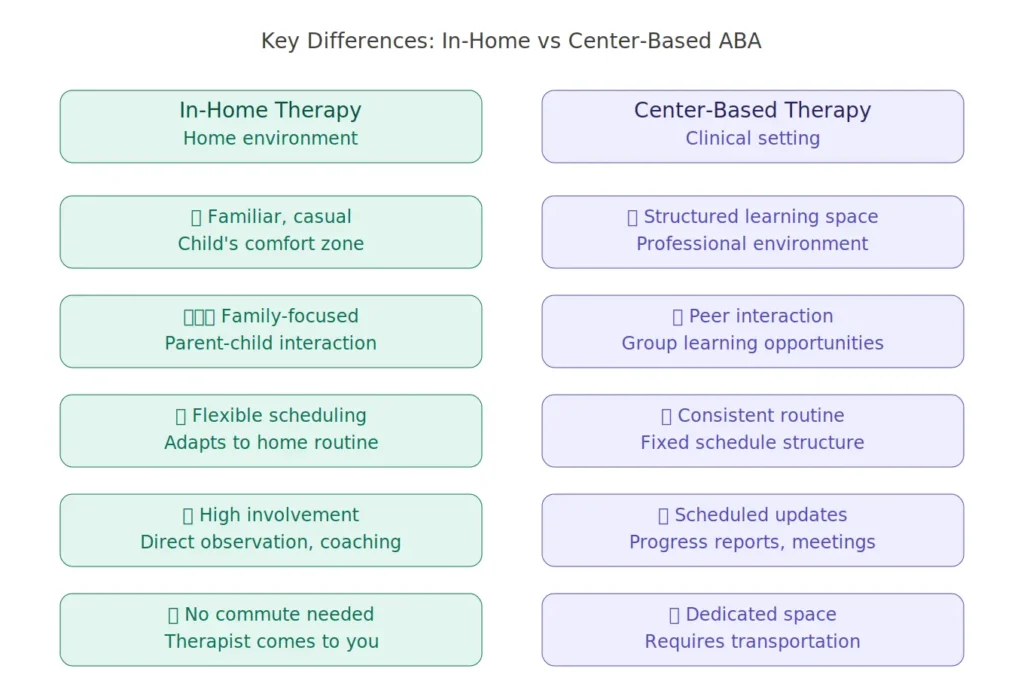
Understand the key differences to make decision-making easier.
- Learning environment: In-home therapy happens where the child feels at ease. The setting is casual however, center-based treatment is done in a learning-focused space.
- Social interaction: Centers often provide more opportunities to interact with other children. Home sessions focus more on family interaction.
- Structure: Centers typically follow a consistent routine. Home sessions may be more flexible.
- Parent involvement: Parents may be more involved during home sessions because therapy occurs in their living space.
- Travel and convenience: Home therapy removes the need to commute. Center therapy requires transportation but offers a dedicated learning environment.
ABA Therapy Pros and Cons
Looking at the pros and cons of ABA therapy can help families understand both options clearly and see how ABA therapy can help their children reach their full potential.
In-Home ABA Pros
- Natural environment learning
- High parent involvement
- Comfortable setting for the child
- Easier practice of daily routines
In-Home ABA Cons
- Possible distractions
- Fewer peer interaction opportunities
- Limited therapist collaboration
Center-Based ABA Pros
- Structured teaching environment
- Direct supervision from professionals
- More therapist collaboration
- Socialization opportunities with peers
Center-Based ABA Cons
- Travel required
- Less focus on home routines
- Adjustment to new environment
Focused vs Comprehensive ABA
Another factor parents may hear about is focused vs comprehensive ABA. Focused ABA targets specific skills. For example, a child might work on communication or reducing one behavior.
Comprehensive ABA assists youngsters with many skills. Conversation, social skills, and everyday routines are covered. It also prepares children to study. Focused ABA targets specific skills. However, comprehensive ABA covers several skills. Both types of ABA can work at home or in a center, it just depends on what’s best for the child.
Factors to Consider When Choosing
The choice between home and center therapy depends on several criteria. What suits you is key. You must weigh several factors before choosing.
- Therapy goals: If you’re working on daily tasks like using the bathroom or following routines, home treatment may work. However, a treatment facility may be preferable for social skills and school preparation.
- Child personality: Some children like calm, familiar places. Others do well with routines and being around other kids.
- Family logistics: Transportation, scheduling, and work can affect your choice. Home therapy can reduce travel time.
- Parent involvement: Families who want to observe and participate more closely may prefer in-home sessions.
Hybrid ABA Therapy: Using Both Settings
Many families do not choose just one option. Some children benefit from a hybrid model. For example, therapy may start at home to build comfort and daily routines. Later, the child may transition to a center to practice social skills and prepare for school.
This combination allows children to gain the advantages of both environments. A child can learn communication skills at a center and practice them at home during supper or play. ABA therapy can be customized for each child, so programs change as they learn new abilities.
Choosing What’s Right for Your Child
Learning varies by child, one kid’s solution may not work for another. Your child’s needs determine home or center-based ABA. Consider comfort, learning style, and goals.
Some youngsters flourish at home and others need centering and socializing. Most significantly, the therapy plan should improve your child’s confidence and growth. Our specialists of ABA Therapy in Brooklyn can help you find the finest option for your child.
Final Thoughts
It can be difficult to choose between in-home and center-based ABA. Both methods help developmental kids. Home treatment emphasizes comfort, spontaneous learning, and family engagement. Centre therapy gives structure, teamwork, and socialization. Goals, personality, and family routine determine the ideal option for your child. Some families use both as their child grows.
Kids learn success skills in ABA therapy. These skills help kids become independent and simplify life. Kids can gain confidence and learn new skills with guidance and a healthy atmosphere. This helps kids succeed at school, home, and community.